How SELBI operationalises the Technological Pedagogical Content Knowledge framework to support early childhood educators in teaching marine sustainability.
Funded by the Xjenza Malta Research Excellence Programme and hosted at MCAST, SELBI was initiated to address a foundational gap: early childhood educators lack the specialist knowledge and resources to teach blue skills — the competencies needed for a sustainable blue economy.
The project assembled an interdisciplinary team of six researchers spanning ECEC, marine biology, AI, and research administration. Its aim is to integrate and enrich the acquisition of blue skills in ECEC by developing a specialised RAG platform that delivers tailored responses aligned with developmental levels within a controlled environment (TRL 4).
Drawing on the socio-cultural paradigm, SELBI positions the platform as a "more knowledgeable other" (MKO) — scaffolding educators' capacity to teach outside their direct expertise, while preserving their professional agency.
RQ1: Can a locally hosted RAG system accurately retrieve and synthesise expert-curated blue economy and ECEC pedagogy content?
RQ2: To what extent can the platform generate developmentally-appropriate and scientifically-sound educational materials that integrate blue skills into ECEC?
"The SELBI platform is not merely a search engine or a generic chatbot; it is a purpose-built intersection of Content Knowledge, Pedagogical Knowledge, and Technological Knowledge."
TPACK posits that effective technology-enhanced teaching requires the simultaneous integration of three core knowledge domains. At their intersection, educators are optimally positioned to make pedagogical decisions about how technology can best convey content to learners.
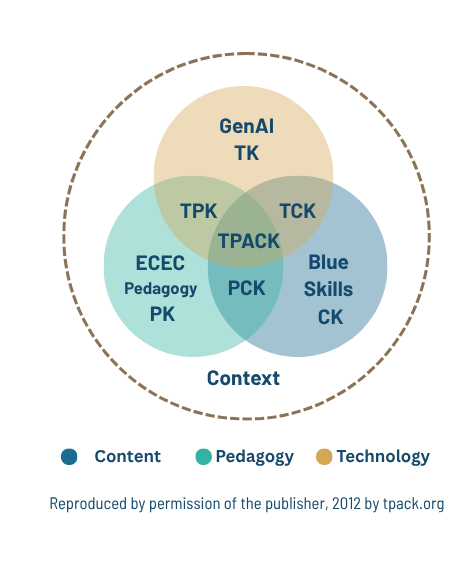
The RAG-based generative AI platform, locally hosted on open-weight models. Developed by the AI experts on the team.
ECEC pedagogy grounded in Malta's National Curriculum Framework, Learning Outcomes Framework, and pedagogically appropriate practice.
Blue skills covering zoology, communities at sea, oceanography, biodiversity, pollution, and climate change. Curated by the marine biologist.
Rooted in Vygotsky's Zone of Proximal Development, SELBI extends the MKO concept to argue that a domain-specific GenAI system can fulfil this role for educators who lack specialised subject-matter expertise.
The platform serves as an MKO for the educator, not directly for the child. This distinction is consequential: it empowers educators to make informed pedagogical decisions rather than automating the teaching process itself.
This approach aligns with Industry 5.0's human-centric paradigm, the UNESCO AI Competency Framework for Teachers, and the OECD's framing of "teachology."
"Early childhood educators are specialists in child development and pedagogy, but they cannot reasonably be expected to hold deep knowledge across all scientific domains, including marine biology."
"By reducing the cognitive load associated with unfamiliar scientific domains, the platform empowers educators to facilitate interdisciplinary blue skills acquisition while preserving professional agency."